Wedding Website FAQ Wording for Nikah and Walima
Write clear wedding website FAQs for your Nikah and Walima with 12 adaptable answers on RSVPs, guests, arrival, attire and practical arrangements.
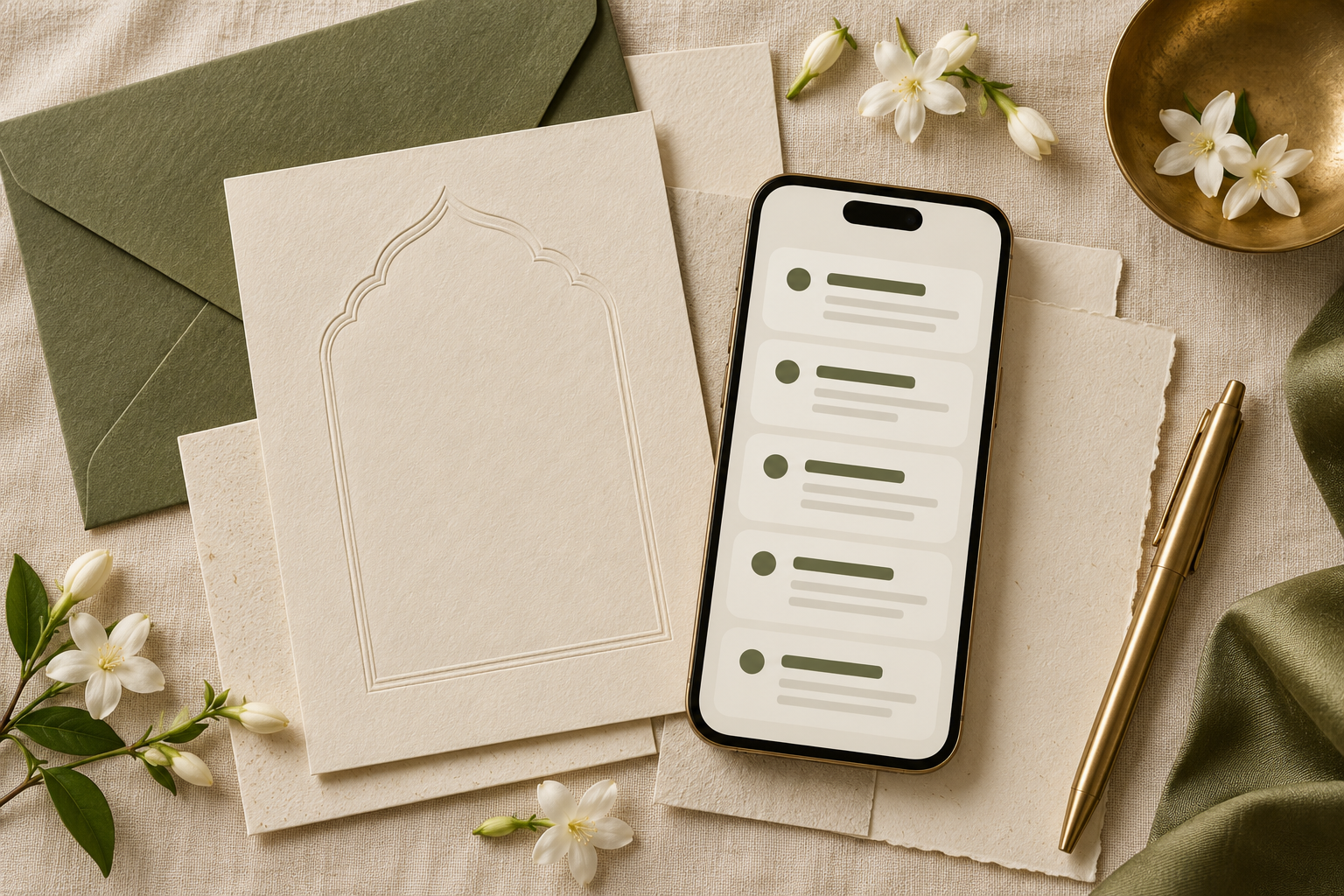
A useful wedding website FAQ answers the decisions guests need to make: when to arrive, which celebration they are invited to, how to reply and who can help. Write the answer first, add the practical detail, then give a next step if one is needed.
For a Nikah and Walima, the important distinction is often the event. A dress request, guest list or venue arrangement may apply to one gathering and not the other. Naming the celebration in the answer prevents a short FAQ from creating a new misunderstanding.
Below are 12 original wording examples you can adapt, followed by a review checklist. Replace every bracketed detail, choose only the answers that fit your plans and confirm arrangements with the people responsible before sharing them.
Decide what belongs in your FAQ
Start with questions your guests have already asked. Then read the invitation as someone who has never visited the venue and does not know your family’s plans.
General wedding FAQ guidance from The Knot includes replies, directions, attire, children and plus-ones. Use those subjects as prompts, rather than copying another wedding’s rules.
Keep the main invitation useful on its own. The event name, date, time and venue should be easy to find without opening a long list of questions. Use the FAQ to explain details such as whether the stated time is for arrival or the ceremony.
For several celebrations, check your Nikah and Walima itinerary before writing. If different people are invited to different events, resolve how their invitations will be shared first.
RSVP and event details
1. How and when should we RSVP?
Example wording: “Please reply by [full date] using [the RSVP section / named contact and contact method]. Let us know which invited guests will attend [event]. If your plans change after replying, please contact [name].”
Choose one clear response route. If the website accepts household replies or separate event answers, test those fields before referring to them. Avoid telling guests to select options that their actual form does not offer.
Set the deadline around your own catering and seating decisions. Our RSVP guide for overseas guests covers uncertain travel plans and household responses in more detail.
2. Are we invited to both the Nikah and Walima?
For a Walima invitation: “We look forward to welcoming you to our Walima on [date] at [venue]. The event details in this invitation are for the Walima.”
For guests invited to both: “We would love you to join us for both the Nikah and Walima. Please check the separate date, time and venue shown for each celebration.”
Use the version that matches the recipient’s invitation. Avoid a universal answer saying “all events are open to everyone” unless that is genuinely the plan. A general FAQ cannot correct an invitation that was shared with the wrong guest group.
3. What time should we arrive?
Example wording: “Please arrive from [arrival time] for the Nikah, which is scheduled to begin at [start time] on [full date]. These times are local to [venue city].”
State an arrival window only when the venue will be ready to welcome guests. If you have published one time throughout the invitation, explain exactly what that time means rather than introducing a conflicting second start.
For a Walima on another day, give it its own answer or a clearly labelled second sentence.
Wording for guest arrangements
4. What should we wear?
Example wording: “For the Nikah, please wear [confirmed dress guidance]. At [venue], guests are asked to [specific venue requirement]. For the Walima, [confirmed dress guidance].”
Replace broad phrases such as “dress appropriately” with useful details. If a venue has footwear, head-covering or other requirements, check the exact guidance with the venue and hosts. Include it because it applies to this celebration.
Do not assume one clothing rule describes every Muslim wedding. If a colour is optional, say that it is a preference. Mention practical conditions, such as a garden surface, only when they are confirmed.
5. Can I bring a plus-one?
When additional guests are not included: “We have arranged places for the guests named in your invitation. We are unable to add further guests. Thank you for understanding.”
When a guest is included: “If your invitation includes a guest, please send their name with your reply so we can include them in the seating plan.”
Be warm and direct. You do not need to invent a venue rule or explain your budget to make the answer clear. Resolve individual questions privately rather than listing exceptions or guest names on the website.
6. Are children invited?
When children are included: “Children named in your family’s invitation are welcome at [event]. Please include them in your reply so we can plan the places required.”
For an adults-only event: “Our [event] will be an adults-only celebration for guests aged [age] and above. Thank you for making arrangements in advance.”
Specify the event if the Nikah and Walima have different plans. Only mention childcare, children’s meals or a quiet room if those arrangements exist. Avoid describing the decision as a “night off” for parents; tell them what is planned and let them make their own arrangements.
7. How should we share dietary requirements?
Example wording: “Please contact [name] privately by [date] about dietary requirements for [event]. We will check the available arrangements with the caterer and reply to you directly.”
This gives guests a next step without promising that every request can be accommodated. If you add information about the menu or food preparation, confirm it with the caterer first.
Keep individual dietary details out of a public FAQ. The page needs a contact route, not a list of guests’ requirements.
8. What access arrangements are available?
Example wording: “The [event room] is reached via [confirmed entrance and route]. For questions about steps, lifts, toilets or seating, please contact [name] before your visit so we can check the details with the venue.”
Specific facts are more useful than saying “fully accessible” without explanation. Confirm the route to the actual event space, including any movement between ceremony and meal areas.
Guests can decide what information they need to share privately. Do not request medical histories on a public page or assume that one arrangement will work for everyone.
9. Is there somewhere to pray?
If confirmed: “A prayer space is available at [confirmed location] during [event]. Please ask [host or venue contact] for directions.”
If arrangements are still being checked: “Please contact [name] about prayer facilities at [venue]. We are confirming the arrangements with the venue team.”
Use the answer that reflects the current position. Check any further details guests may need, such as opening times and relevant facilities, before adding them. This is practical venue information; avoid presenting your family’s arrangements as a rule for other celebrations.
Travel, photographs and help
10. How do we reach the venue and where can we park?
Example wording: “Please use the map link in the [event] details and enter through [confirmed entrance]. [Confirmed parking or drop-off information].”
If a shuttle is arranged, add its exact pickup point, departure time and any booking requirement. If it is not arranged, do not leave wording that implies transport is included.
Check the map link on a phone and make sure it leads to the intended entrance. Keep detailed hotel and travel notes in the appropriate guest-information section, with a clear reference from the FAQ if needed.
11. Can we take or share photographs?
For a ceremony without guest photography: “During the Nikah, please keep phones and cameras put away. [Confirmed photography guidance for the Walima or later gathering].”
For a request about online sharing: “Please ask before posting photographs of the couple or other guests online. We would appreciate keeping photographs from [specified event] within the invited group.”
Choose wording the hosts have agreed and make the scope clear. A request about sharing is not a technical restriction. If the invitation link or photographs may be forwarded, our wedding invitation privacy guide can help you decide what to publish.
12. Who should we contact with another question?
Example wording: “For questions before the wedding, please contact [name and agreed contact method]. On [event date], [name and agreed contact method] will help with arrival and venue questions.”
Ask each contact before publishing their details, and make sure they know which questions they are handling. A family member who can explain the guest list may not be the person coordinating parking.
If a venue or time changes, update the website and tell affected guests directly. Do not assume they will reopen the FAQ and notice the correction.
Check the wording before guests see it
Review the FAQ with the people who can confirm the answers: the hosts for guest arrangements, the venue for facilities and the caterer for food questions.
Then use this final checklist:
- Every answer belongs to your wedding: remove copied arrangements you have not made
- Events are named: a Nikah-only instruction is not presented as a rule for the whole celebration
- The invitation and FAQ agree: dates, times, venues and response deadlines match
- Placeholders are replaced: no bracketed names, dates or instructions remain in your guest-facing copy
- Links and response routes work: test the actual form, map and contact method on a phone
- Private details stay private: remove guest lists, individual requirements and internal planning notes
- A fresh reader can follow it: ask someone outside the planning group to find the arrival time and explain how to reply
Keep an approved copy of the wording so later edits can be checked against it. If an answer is long, lead with the practical answer and link or direct guests to the fuller details.
Common questions about writing a wedding FAQ
How many questions should we include?
Include the questions that help your guests attend confidently. The 12 examples here are a selection to adapt, not a required number. Remove irrelevant questions and add any real concern that your invitation does not already answer.
What if an arrangement is not confirmed yet?
Say what is still being checked and give a contact route where useful. Do not publish a guessed facility, transport service or meal option. When the answer becomes important to someone’s travel or attendance decision, contact that guest directly.
Should the FAQ be bilingual?
Use the languages your guests need. Have a fluent reader review each version, especially event names, restrictions, times and instructions. Check both versions after an edit so one language does not retain an old answer.
Bring your guest information together
Noor’s wedding websites bring event details, venue maps and guest RSVP collection into a mobile-friendly invitation. Share your proposed FAQ with Noor and confirm how the chosen design can present that information before assuming a particular layout or extra section is included.
Discuss your wedding website with Noor with your event list and approved guest answers. A short, accurate FAQ gives guests something useful to return to whenever they need a detail.
Explore Noor’s four wedding website samples.
Open each live sample, compare the experience and ask us which design fits your celebration.
Two more useful reads.
 01
01Your Muslim wedding website checklist
The names, timings, family details, venue information and photographs to gather before making your Muslim wedding website.
Read the guide → 02
02Thoughtful wording for Nikah and Walima invitations
Practical Muslim wedding invitation wording for family introductions, Nikah details, Walima invitations and a warm guest welcome.
Read the guide →