Wedding Website Accessibility Wording for Nikah and Walima
Write clear venue access notes with verified routes, practical wording examples and a private way for guests to ask questions.
Describe the route, not just the reassurance
Wedding website accessibility wording should explain what guests will encounter at each venue, what has been confirmed and who can answer a private question. For a Nikah or Walima, “Everyone is welcome” is a warm introduction, but it does not tell someone whether there are steps between the entrance and their seat.
Start with specific, verified facts. Keep uncertain details clearly labelled. Avoid calling a venue “fully accessible” unless you can explain what that means for the actual event setup. A beautiful invitation can be welcoming without promising arrangements that have not been checked.
Separate venue access from website readability
These are two different checks. A guest may be able to read your invitation easily but still need information about a gravel path, a lift or the nearest drop-off point. Equally, a step-free venue description is not useful if it is buried inside a small image that guests cannot comfortably read.
This guide focuses on physical venue information and guest communication. For the invitation itself, see Noor's guide to readable invitations for older guests. Do not assume that older guests are the only people who need access information, or that everyone with the same condition needs the same arrangement.
What to ask the venue before writing
Walk through the actual guest journey with the venue contact. Confirm the setup for your celebration, not merely a generic description of the property. A hotel lobby may have a level entrance while the lawn used for your Walima has a separate route.
Build a short fact sheet with these headings:
- Arrival: the correct entrance, drop-off point and route from parking.
- Movement: steps, ramps, lifts, surfaces and any changes of level between event spaces.
- Seating: where guests can sit during the ceremony and meal, and how a specific request will be discussed.
- Facilities: the location and confirmed features of toilets available to guests.
- Environment: whether the celebration is indoors or outdoors, and whether any quieter space has actually been arranged.
- Help: an approved contact who knows the venue and can follow up on individual questions.
Record who supplied each answer and when it was checked. If a measurement matters to a guest's decision, obtain it from the venue rather than estimating from a photograph. Share a verified venue access page if one exists, while making clear which rooms your event will use.
The NSW Government's accessible-events toolkit is a useful planning reference for checking barriers and communicating access information in advance. It is not a certification of your venue or a statement of the rules that apply to a wedding in India.
Four wording examples to adapt
The examples below are fictional templates. Replace every bracket with confirmed information. Do not copy a feature into your invitation merely because it appears in an example.
1. A confirmed step-free route
Venue access — Nikah
Please use [entrance name] for the step-free route to [ceremony room]. The route from [drop-off point] is [confirmed surface or route description]. [Confirmed toilet information]. If you would like more detail about the route or seating, please contact [approved name and private contact method].
“Step-free” describes a particular route. It does not automatically establish that every doorway, toilet, seat or transport option will meet every guest's needs. Give guests enough information to ask the right follow-up question.
2. Different arrangements for Nikah and Walima
Access information for our celebrations
Our Nikah will take place in [room, venue]. Access is via [confirmed route]. Our Walima will be in [room or outdoor space, venue], reached by [confirmed route and surface]. Please contact [name] if you need information about either location before planning your journey.
Keep the two events separate even when they share one address. A single map pin can hide an important difference between a ground-floor ceremony and an upstairs reception. Link the relevant arrival note from your transport information rather than leaving guests to combine conflicting directions.
3. A known limitation
Please note before planning your visit
The route to [event space] includes [confirmed number of steps or other specific limitation]. [Verified alternative route, if one exists]. Please speak with [contact] so we can discuss the available arrangements with the venue before the celebration.
Do not replace this with “Our team will help everyone inside.” That promise may not describe a safe or suitable option. Explain the limitation plainly, then discuss what is genuinely available without assuming a guest will accept a particular form of assistance.
4. A detail still being confirmed
Venue access update
We are confirming [specific detail] with the venue. We will update this section by [realistic date]. If this information affects your travel or attendance plans, please contact [name] now so we can follow up directly.
Use this only with a real follow-up plan. It is better than presenting an unverified answer as fact, but it should not become a permanent placeholder. Once confirmed, replace it with the actual information and tell any guest who was waiting for it.
Invite questions without asking for a diagnosis
A useful private prompt is: “Is there an arrangement or piece of venue information that would help you plan your visit? Please message [contact] so we can discuss it with you.”
Ask about the practical requirement, not a medical history. Do not publish a guest's access request, name or personal circumstances in the public FAQ. Share only the information needed with the person arranging the agreed support, and agree that sharing with the guest first.
Choose one primary contact and a backup rather than listing several relatives without responsibilities. The wedding website contact wording guide can help you make that route clear. A deadline can help with advance planning, but avoid implying that later questions are unwelcome.
Where to put the information
Use a visible heading such as “Venue access” or “Access and arrival”. Place it near the venue details, then include a short pointer in the FAQ. Guests should not have to open a decorative photo, watch a video or guess a password merely to find the contact route you intend them to use.
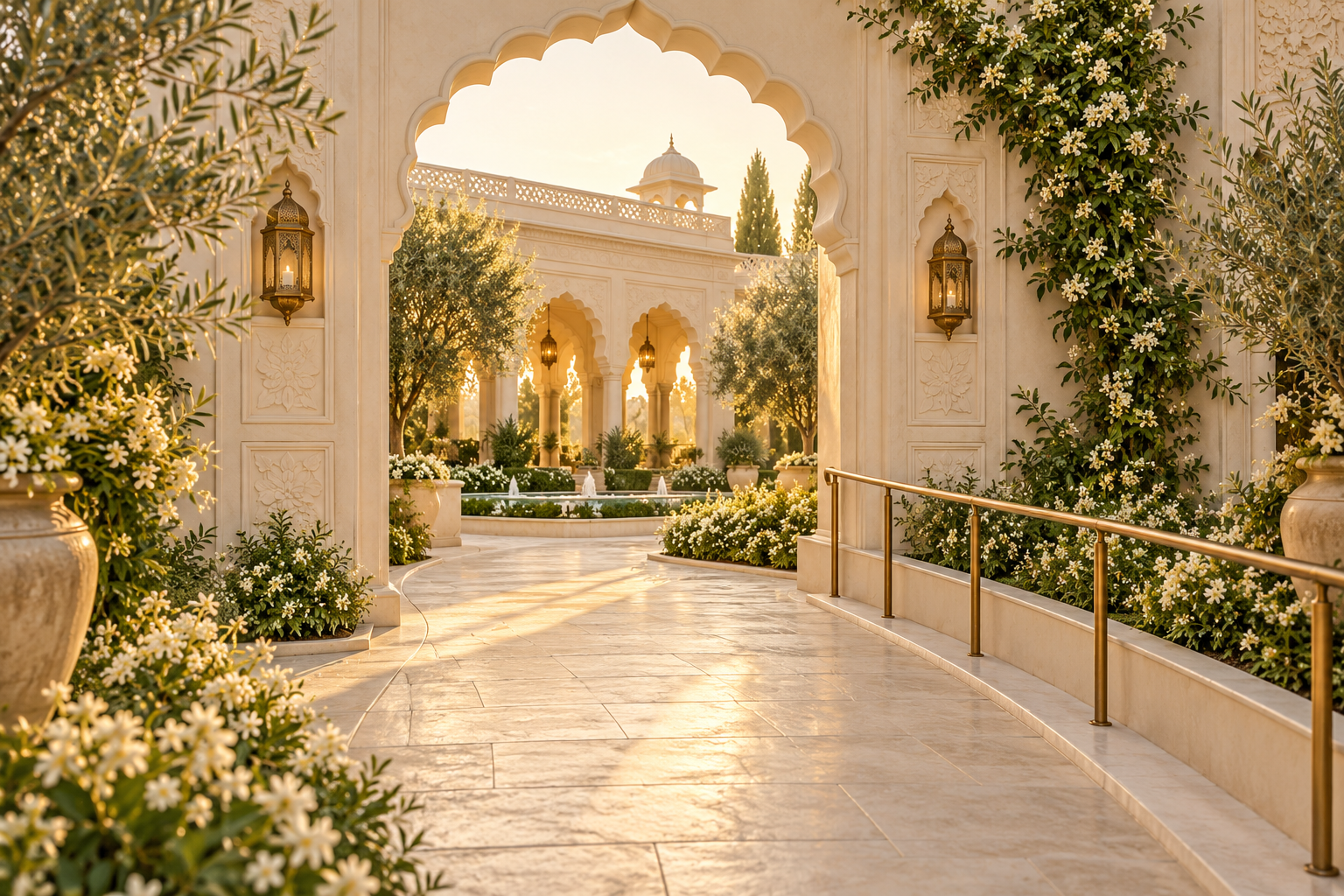
Keep the main facts in selectable text. A simple route photograph can support the explanation when it is current and approved, but describe what it shows. Do not use a generated illustration as evidence of a real entrance or ramp. The cover of this article is conceptual artwork, not a photograph of an available venue.
Noor's wedding websites bring event details, maps and RSVP information together. When preparing your brief, ask where the verified access notes should sit within your chosen design and confirm any extra layout or form requirements separately. A wedding website is a communication tool; it does not verify a venue's physical facilities for you.
A final review before sharing
Ask a reviewer who was not involved in the planning to find the answers to these questions from the guest-facing page:
- Which entrance should I use for my event?
- What steps, surfaces or changes of level should I expect?
- Which details are confirmed, and which are still pending?
- Who can answer a private question?
- Does the answer differ between Nikah and Walima?
- Does the page agree with the directions message and venue's latest information?
Test the actual published link on a phone. If your venue changes a room or route, update the wording and contact affected guests directly; do not assume everyone will reopen the page. Keep the broader wedding website FAQ concise by linking to the access section instead of repeating a second version of the same facts.
Frequently asked questions
Should we write “wheelchair friendly”?
Specific information is more useful than a broad label. Describe the confirmed route and facilities, link to reliable venue details and offer a contact for further questions. Do not imply that one phrase answers every guest's requirements.
What if the venue says it is accessible?
Ask what that covers for the rooms and outdoor areas used by your wedding. Check the journey between spaces, not only the main entrance. Publish the concrete answers you receive rather than expanding a general reassurance into a guarantee.
Should we collect access requests in the RSVP?
Only if the agreed response process supports it appropriately. Provide a private alternative for guests who would rather talk. Confirm who can see responses, and do not assume that a generic RSVP field is the right place for sensitive details.
Can we use the same note for both celebrations?
Yes, if the routes and arrangements are genuinely the same. Otherwise label each event separately. Clear distinctions help guests plan without having to ask whether a detail applies to them.
Make the welcome practical
The strongest access wording is calm, specific and honest. Check the facts, acknowledge limitations and leave a clear private route for questions. That gives guests useful information while keeping the invitation warm and personal.
Explore Noor’s four wedding website samples.
Open each live sample, compare the experience and ask us which design fits your celebration.
Two more useful reads.
 01
Your Muslim wedding website checklist
The names, timings, family details, venue information and photographs to gather before making your Muslim wedding website.
Read the guide → 02
Thoughtful wording for Nikah and Walima invitations
Practical Muslim wedding invitation wording for family introductions, Nikah details, Walima invitations and a warm guest welcome.
Read the guide →